Tuesday, October 15, 2013

Cape Breton Highlands N.P. and the Cabot Trail


With the music festival due to start in 3 days we had plenty of time to do the 298 km Cabot Trail, which is actually a road that winds around, up and down the low and highlands of the park. It is a marvel of engineering built in the 1920's. It is kept open year round which has got to be a challenge considering that the highlands of the park get 500+ cm of snow in winter. We decided to do it clockwise in order to be in position at the end for our first music concert in Sydney. 
 We started the drive heading north up the west side of the island. I got my geology fix early by getting to see the major rock formations lined up neatly on the edge of the beach. For clarity they aligned themselves vertically so that I could march along and identify each layer without having to lean over or anything difficult. Starting at the south end of one small beach I saw dark slate rocks peeling off the cliff, aged about 4-500 million years. Right next to them were thick layers of large crystal, lovely pink and orange granite with stripey intrusions of white and black, these guys are younger at about 380 million years. At this point a small lake had formed where lots of soft sandstone had eroded quickly away and on the other side of that was the currently eroding soft sandstone bluffs, aged about 350 million years. The beach covered with a colorful array of smooth rocks that rolled and tumbled with the surf. 
P1110500
P1110495
P1110518


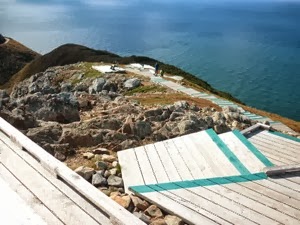
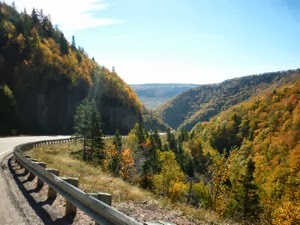
As we continued past this beach the road began to climb and twist through the forest and over headlands. The fall colors were really getting going at this point, Thayer struggled to watch the road and admire the fantastic scenery at every corner. Fortunately there were lots of scenic pullouts where we stopped to gape and take photos. We could look all the way up the coast, seeing the twists and turns of the road ahead. The skies had pretty much cleared, just the occasional puffy cloud cruising by hoping to get into the photo. Once we got up onto the plateau we stopped for the "must do" hike, the Skyline Trail. It meandered through the stunted trees and colorful meadows to an amazing boardwalk and views out over St. Lawrence Bay to the west. The boardwalk had about 270 steps connecting sections of the walkway. It was built to keep people off of the delicate plants that struggle to survive and take years to recover when trampled by thousands of feet during the summer months. The return part of the hike led us through more sheltered woods and meadows. We were delighted to see two moose, the bull, sleeping in the woods and the cow feeding near the trail. She posed nicely for her photos, showing off her sleek coat and fat haunches. She was a fine looking specimen.
P1110525
West side Cabot Trail
P1110536
Skyline Trail boardwalk

P1110582

P1110554
Madame Moose

P1110583
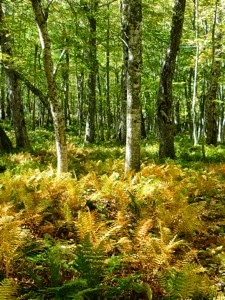
Fall colors on the highland
At the beginning of the hike we were walking and talking with a very interesting German named Klaus. He was riding a bike around the Cabot Trail and then will write articles for several magazines. Nice gig! Get a magazine to pay your expenses, get some companies to give you a groovy collapsable bike to ride and a bunch of brightly colored hi-tech clothing and off you go! We continued down the road to Pleasant Bay, joined Klaus for a beer at his lodgings and spent the night right above the beach near the marina. It was a wonderful starry night with crashing waves lulling us to sleep. 
P1110565
Pleasant Bay beach
P1110697
Yes, many of these
The next day was a beaut! Bright sun, a brisk breeze and amazing fall colors blooming all around. We did a short walk through the only old growth Sugar Maple forest in Nova Scotia. Though the trees are not huge like we think of when we think "old growth" they were beautiful and had a lot of character. We drove on, up huge hills, down steep grades, around bends and ridges, stopping at many of the overlooks for awesome views. At one pullout we noticed a rig very much like our, actually a precursor to ours, that we had seen on PEI. We pulled up next to them and we started to chat. Jean Ramon and Lizette are from Quebec and are on a 3 month RV jaunt before heading to Japan and Bali. 

Down, down, down we went into the North Aspy River area, a fascinating geologic area. It runs along fault line that is straight as an arrow with the west side several hundred feet higher than the east side, a result of different types of rock eroding at different rates. I went for a lovely hike through the maple woods seeing not a single other person in 3 hours. 
P1110644
Aspy River sugar maples
P1110628
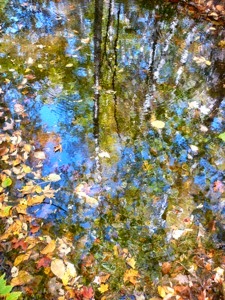
reflecting pool in the woods

Leaving the park, we headed to the very remote little town(pop=10?) at the northern most point of Cape Breton called Meat Cove. The last 8 km of road was a gravel road that climbed and dived along the cliffs overlooking the bay. The wind was howling and I thought we had made a big mistake. I was not convinced that we would be able to get out of the tiny little flat space occupied by the town. We found the single spot in town where we could camp for the night in the parking lot of the closed Chowder Shack. It did have an incredible view. We did the two attractions in town, the windswept beach, hemmed in on each end by towering cliffs, and the rickety boardwalk that went from the beach up the hill to the only open business in town, a restaurant. Still worried, I took my sleeping aide and survived the night.
P1110668
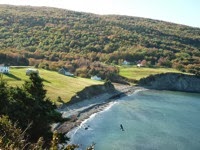
Meat Cove beach
P1110655
Dizzy heights on way to Meat Cove
P1110666
Bluff over Meat Cove
The next morning we started the climb out of the town. As we passed the restaurant we saw two fellows hitchhiking so we decided to pick them up, they looked a little wild but ok. Thomas, from Holland, and Zack, from Vancouver and Seattle, distracted me from the road and before I knew it we were back on the Cabot Trail. We spent the rest of the day with our new friends, stopping at the Keltic Lodge and taking a splendid hike out to Middle Head. The Keltic Lodge had a comfortable and lovely sitting room but we didn't stay to enjoy it, as Thomas and Zack needed to get down the road. We were all headed to St. Ann's for some musical entertainment that evening. Once we arrived they ran into some people they had met at Meat Cove and introduced us. Leo and Mady are from La Reunion, a French territory(?) in the Indian Ocean. They are driving a classic old VW camper van, complete with a wild paint job, to the west coast of the US. We all ended up going to the music performance together and then camped out at a great spot nearby. Thomas and Zack had been couch surfing, WOOFing (work on organic farm) and were not very well equipped for the tenting they had been doing for 2 nights. It was pretty dang cold so we loaned them our down sleeping bags and a ground pad, and they were very grateful and much warmer. The following day Leo and Mady took them to the ferry bound for Newfoundland. 
P1110682
Breakfast with Zack and Thomas
P1110683
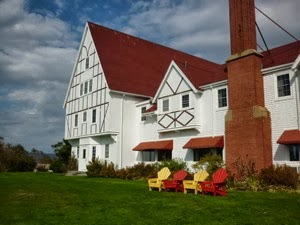
Keltic Lodge sitting room

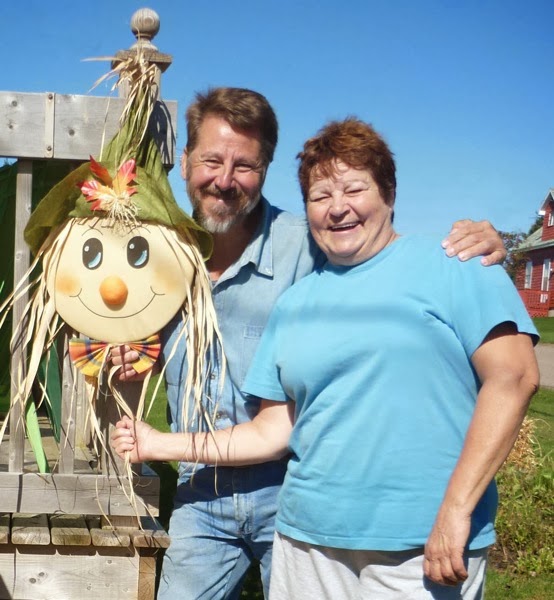
We ended up having an amazing time driving the fantastic Cabot Trail and seeing Cape Breton Highlands NP, but the best part of it all was meeting a bunch of fun and inspiring folks, all looking for adventure in different ways. Watch for some of them to reappear in the next post as we kept bumping into each other in unexpected places. We are starting to feel like locals, we have so many friends!


P1110720
Thayer, Leo, Mady, Thomas, Zack, me
P1110716
East side Cabot Trail


P1110713
Keltic Lodge CBHNP
P1110711
Middle Head hike
P1110721
Leo and Mady with bus

Cape Breton

P1110446Upon leaving PEI, we drove quite directly to Cape Breton Island, which is the northern part of Nova Scotia. There is just a short causeway that you cross to get from the mainland to the island. At the Visitor Center I was loaded up with books and brochures so I could get thoroughly confused in a short period of time. I think they are trying to get rid of this year's materials by overloading every poor tourist who walks in the door. The most important piece of information we got was that the Celtic Colours International Festival is starting on Oct. 10 and runs for 10 days or so. That allowed us about 4 days to do the Cabot Trail, supposedly one of the most scenic drives in North America. We also wanted to find some of the Celtic music that is played all over the place around here. We stopped at several venues along our route and they were really crowded and had a cover charge so we finally ended up at the Glendora Distillery. For the cost of our wonderful dessert and coffee we were treated to an evening of acoustic music, guitar, fiddle, mandolin, and a couple of numbers involving spoons. We spent that night next to a dark cemetery and church, it was a little spooky...
P1110445 

The next morning we felt as if we had missed something the previous day. We had rushed by the homes of Natalie MacMasters and the Rankin Family (renowned Celtic musicians) and felt the need to go back to the little burg of Mabou. Good thing we did! It was a blustery day and the weather was expected to get worse so we needed to kill some time. The Red Shoe, a restaurant in this tiny town, had free music offered from 5-7 and then fiddle jamming at 8:30. We found some WIFI and I spent 3 hours scouring the Festival website to figure out a plan for the week. After much consideration and considerable confusion, I finally purchased tickets to two concerts and filled in more time with possibilities from the many other options offered for free and low cost. The festival is not just about music, there are events involving art, history, biking, hiking, community meals, storytelling, workshops, dance, and lectures. The venues are all over this large island so to figure out a few days of participating was much more difficult than you might imagine.

P1110467
Fall color along the Salmon Pond walk
Well, after all that hard brain work I went for a nice long walk and when I got back it was about time to go hear some music at The Red Shoe. This restaurant is owned by several of the Rankin sisters and they serve very good food and have live music nearly every day. We ordered the corn bacon chowder and it came in a large bowl with two thick slices of warm, homemade bread. A fiddle and guitar couple played traditional Celtic music that kept our feet busy. After the couple was finished playing the real fun started. At 8:30 they just open up the restaurant to fiddle players who come in droves to play together. At one point there were at least a dozen players, aged 12-70 fiddling away. The music would start out slowly so they kids could play along and then it would get faster and faster until just the best players were playing. A group of kids involved in a Gaelic language program sang a few songs and several of them danced to the fiddle music. It must have been time for the kids to go home and go to bed because at one point the bagpipes were brought out. In such a small space one set of bagpipes can really rattle the windows! The crowd thinned out considerably and by the time the second piper had his turn the evening was over. We really enjoyed the friendly atmosphere and spirited music.  It is wonderful to see music binding the generations of a community together in a way that we don't see in the States. It is a driving force in the culture of this place, an island settled by Acadians, Scots and Irish. 
P1110520
Rock Sculpture by Thayer

Rain pounded down on us the next morning, but we were armed with things to do, thanks to my research from the previous day. We started with the Salmon Museum which should really be renamed the Salmon Fishing Museum. Located near the famous and lovely Margaree River it houses an enormous collection of rods, reels, tied flies, photos of famous salmon fishermen(bet you couldn't name even one!), miscellaneous fishing equipment, poaching gear, nets...and a bit of information about Atlantic salmon. There was a very cute little old lady who showed us around and answered our questions. I did learn some interesting things about Atlantic salmon and the history of fishing here on Cape Breton Is. Atlantic salmon are different from our Pacific salmon in several important ways. After hatching they spend two or three years in the river, growing slowly, until they are ready for the sea. Once they get to the sea, they grow very quickly because of the increased food supply, they live in the sea for several more years. Like the Pacific salmon, they return to the stream of their birth to spawn, but they do not die after spawning. They return to the sea and live to spawn several more times before they die. Since 1984 commercial fishing has not been allowed, and sport fishermen are limited to 4 fish per year and they may only use flies to catch them. It is big business here, people come from around the world to fish the beautiful streams, ponds and rivers. I get the feeling that "catch and release" is the method that most employ these days. They may not keep any fish over 63 cm. The rivers do not have dams on them and the logging regulations attempt to protect habitat unlike our northwest rivers. 

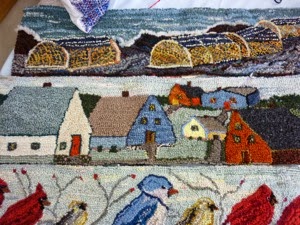
We visited several other places, I saw the Cape Breton form of rug hooking and talked to some hookers in a store. Their work is more detailed than what I am familiar with and is very pretty. Some of the tapestries looked like paintings and are quite famous. We also visited a wood shop where they make beautiful cutting boards out of larch wood. 
P1110732
Cape Breton hooking
P1110450
Larch wood cutting boards
We moved along our route to Cheticamp, the gateway to Cape Breton Highlands National Park. We scoped out the music scene, deciding on the Doryman Tavern for our musical entertainment for the evening. A young lady named Chrissy Crowley played some very energetic fiddle music with an equally energetic piano accompanist. It was quite different from the traditional music we heard the night before but we enjoyed it very much. Their hands move so quickly that they are just a blur!  They were quite engaging and really seemed to enjoy what they were doing. We spent the night in the parking lot behind the tavern and got a good nights sleep in preparation for tackling the park in the morning.
P1110738
Lobster trap wreath
P1110734

Wednesday, October 9, 2013

Prince Edward Island - Part 2


P1110283
Our PEI  boondocker host, Bob

Our first night in Charlottetown we spent with a boondocker host on the peninsula across the bay from the main town. We were lucky to catch Bob, as he was leaving the next day on his own winter adventure to the American SW. He has been going there for several years now and just loves it. He gave us lots of good ideas of what to do once we get to the SW. His darling granddaughter cleaned up her room so she could give me a tour and drew a nice picture to decorate the rig. Happy Trails, Bob!


P1110402P1110404


The next day we spent touring the town, it happens to be a very historic site. The very first meeting of men to ever discuss a Canadian Federation was held here. We rode our bikes around the lovely old homes and parks on the edges of the city. Leaving Charlottetown, we headed north again for the northeastern coast of the island. It was a cool, blustery day so we were happy driving through the countryside, admiring farms and houses and the increasingly beautiful fall colors. We spent the night at the Visitor Information Center in St. Peters. The sun was shining again the next morning so we unloaded the bikes and set out on the Confederation Bike Path which runs over 200 km from the east to the west points of the island with branches in the other directions. It was created on the old railway line crossing the island on a lovely, mostly level grade. We did only a short section from St. Peters to Morell, about 22 km round trip. We saw only a couple of joggers the whole way. We were treated to views across rivers, wetlands and bays as we rode through short stretches of forest and longer stretches of potato fields. Several of those wily spuds jumped in my bike bag on the way home. They grow a LOT of potatoes here and I had been wanting some but didn't want to buy 10 lbs to haul around. I parboiled 'em and fried 'em up for dinner in Souris that night and we had a lovely dinner of smoked salmon and spuds.

That night in Souris (say surrey) we went to our first "ceilidh" (forget most of those letters and just say kaylee) which is an informal gathering of musicians (mostly amateur, but some events have pros), singers and dancers who get together for music and fun. The visitors center had given me a list of ceilidhs that happen all over the island and this was one that was on our path on the right day. It took place in the Silver Threads Senior Center. Admission was $5 but they had the 50/50 drawing where a person could win half of the take for the night. The minute we got out of the rig we were greeted by Kathleen, who parked right behind us, and welcomed into the center. As you could guess, most of the audience were indeed seniors, but there were also some teenagers and middle agers like us. Actually, I fit in quite nicely with all the white haired ladies. A variety of folks played guitars and there was one accordian player, and another player was a young man about 12 or 13 years old. What may have been lacking in the music was more than made up for by the friendliness of the people. We all danced and laughed the night away, snacks were served, potluck style and Kathleen made sure we had a good time. I even won a door prize, which was my $5 back for my admission! By the time it was all over, it was late and we found a small park a couple of blocks away for the night.

P1110383a
Our friend Kathleen
The next morning we woke up and got ready to move by about 9:30. We were just pulling out when Kathleen trotted up and invited us to her apartment for a shower! Well now, we don't pass up chances like that and we always love a good visit with new friends, so off we went to Kathleen's place. After our showers we were served toast and tea with homemade bread! We had a lovely visit, took some photos, and Kathleen loaded us up with fruitcake, applesauce, a loaf of that homemade bread, and a small pile of potatoes (after informing us that "some of those farmers have spy cameras up in the trees and levy big fines to potato rustlers!" We then took a short trip to Isabella's (K's sister) to see her Halloween decorations. More photos and we said goodbye to Kathleen. Like I keep saying, our best times are when we get to meet people and spend some time with them. Thank you Kathleen!
P1110406
We meandered down the eastern coast, stopped at an orchard to pick up some lovely apples, and talked apples for a bit with the farmer. Our destination was Murray Harbor at the home of more Boondockers. Wendy and Larry Siebrand were waiting with glasses of wine and we had a nice visit before dinner and bed. Wendy offered up her washing machine and clothesline which was very much appreciated so the next morning we ran a big load of dirty clothes. Larry and Thayer got involved in hooking up Larry's CB radio antenna while Wendy and I walked to the harbor, bought farm fresh eggs and watched the herring catch being unloaded. The mens' project got more involved and Wendy served us up some wonderful lunch and dinner! It was so nice to eat some real, home cooked, good food! Wendy has several gardens, cans all sorts of tomatoes, beans, relishes, salsa and pickled beets! Those were just the ones I saw or got to sample. Larry has a hard time getting her to travel in the summer because she is so busy with the garden and canning.

P1110411
Never far from water. That's me!
They offered to let us use their kayaks to paddle around the harbor but it was too late in the day and too windy. The next day dawned sunny and calmer. We puttered around all morning, Thayer working on the website and I did some housekeeping. After another great lunch provided by Wendy we loaded up the kayaks in their pickup and drove the 2 blocks to the harbor. It is a tiny harbor with a few fishing boats but you can paddle out into a small bay, seeing eagles, nice beaches and houses, and racks of mussel farms. We paddled a good part of the bay but it was still pretty windy so we headed up the river that flows into the harbor. It was all really pretty and it felt great to be out on the water. When we returned to the house Wendy had fixed us yet another tasty meal which we ate with appreciation and enthusiasm. We had such a fun time with Larry and Wendy, talking about news, politics and books, it was another great boondocking connection and we hope they will come visit us someday after we get home. They are headed south sometime in Nov. or Dec.

P1110432
New friends
The next morning we said good bye to the Siebrands and PEI and continued our trip toward Nova Scotia and Cape Breton.  I am having a hard time waiting a few weeks before eating our "Dilly Beans" that Wendy sent along with us. We will think of Wendy and Larry very fondly when we tuck into those little goodies.

P1110373
I've heard every excuse
P1110328
Catsup or lobster flavor? It's so hard to decide!
P1110368
These aren't so big up close

Tuesday, October 1, 2013

Prince Edward Island - Part 1

P1100643
Beach at PEI National Park

At last! The big turning point that we have been looking forward to. This was the destination for September! Home of Anne of Green Gables fame, interesting history, beautiful farm scenery, fabulous beaches, quaint little towns, entertaining maps....where to start, where to start? Our first day dawned cold and raining and blowing, not all that promising. We had some internet so we muddled through part of the day, really itching to get somewhere but hardly able to see anything with the rain and wind. Finally, about 3:00 I was getting cold and bored so we packed up and headed up the road. We took part of the scenic road, mostly rainy coastal views. We decided to go to the Acadia Museum to glean some history of the island. 
P1110060
North Cape Lighthouse
P1110068
Sea Cow Bay Lobster Boats
The Acadians descended from the first French settlers to come to this area. They were quite successful with agriculture and fishing, managing to grow and catch most foods that they needed and trade for the other necessary items. In the mid 1700's when the British took over they decided that all of the French living on the island needed to sign an oath of allegiance to the crown. The Acadians refused, and they were forcibly rounded up and shipped off either to the Louisiana territory, where they became the Cajun population or back to Europe. 2/3 of them didn't survive the trip, it was a massacre. A few escaped to the mainland and a small group went into hiding here on the island. The British then divided up the island and gave it to a bunch of Brits who didn't even live on the island. A number of years later the Brits allowed the the Acadians to return to PEI, to be tenant farmers for the owners. It wasn't until over 100 years later that they got their lands back after the brand new Canadian government bought the land back from the British.
 They organized themselves into cooperatives of all kinds that exist today. We have seen fishing, grocery, gas, farming, and business co-ops all over the island. The 15-18 families that stayed here during the bad times formed the backbone of the new community and their names are everywhere, street, stores, most grave markers, businesses, and farms. The Irish also have a long history here and have integrated into the Acadian Culture. I don't know about today but the Acadians who built PEI were exceedingly hard working, had huge families, and were very loyal to their roots and their culture. You definitely get the feeling that not too much has changed in that regard. It took me a while to understand why so many homes had a "Texas Star" tacked to their homes and barns. At the museum we saw that their flag is the red, white and blue stripes like the French flag, but the Acadians have added a gold star to the blue field. I don't know what the protocol is for hanging a star but there are a lot of them!
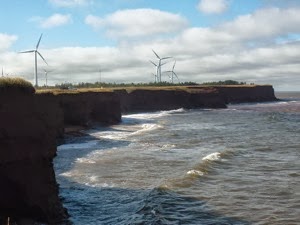
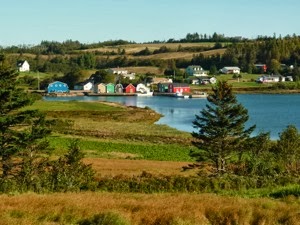
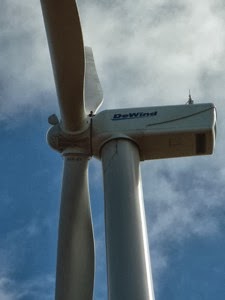
The island is roughly organized into 3 sections....We did the northwestern section first, driving along the coast in the rain to get to the North Cape area. We stayed at a boondocker site in Tignish at the very north end. The owner wasn't even home so it was a nice quiet night next to a large church and cemetery. The next morning dawned with sunshine and a brisk breeze. We headed up to the North Cape wind farm, a collection of at least 20 large wind generators cranking away in the fresh wind coming off the Gulf of St. Lawrence. They also have a nice nature walk around the cape with signs giving information about geology, bogs, birds, and fishing. On our way away from the cape we stopped at Sea Cow Bay to photograph the lobster/fishing boats and talked to a couple of fishermen. Their mainstay is lobster, there are two seasons, spring and fall. By Oct. 10 the season is over and the boats are hauled out. Many boats are stored at peoples' homes so you see large lobster boats inland, parked next to a barn or house. A specialty fish that they also fish for is blue fin tuna. A single fish can bring in 1000's of dollars from Japanese buyers. Each boat gets a limit of one tuna, then they have a lottery for the 50 or 60 tags that are left over. We learned a few days later that a big one had been caught, over a thousand pounds! That made the news!
P1110036
Can you see the worker up top?
P1110011
North Cape Wind Farm


P1110119
Boat Ramp sunset
P1110137
French River


We followed the northern coast into the middle section of the island. The highlights here are the Anne of Green Gables Heritage Site and the PEI National Park. I never imagined there would be a National Park dedicated to a children's author and her books but my, have they done it here. I never read the "Anne" books but we watched the BBC series on our way to Canada. I'm almost an expert.

P1100623a
St. Mary's

The setting for the books was inspired by the Cavendish area, where the author spent her childhood. Green Gables was the farmhouse where Montgomery visited her aunt and uncle when she lived on the island with her grandparents. If nothing else, Montgomery clearly cherished her childhood home and is very much responsible for its preservation and enjoyment by many, many people. Apparently the Japanese have a special fondness for her books and Green Gables is a destination wedding venue for many young Japanese. While we were there, there was a very giddy group of young Japanese ladies striking the most hilarious poses for their photographers.
P1110159
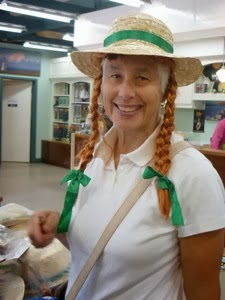
Jill of Green Gables
P1110143
Green Gables
P1110145

 We also enjoyed several days at PEI NP where we lounged on the beach, walked through the woods and wetlands, and I rode my bike around the lakes of shining waters. We read all the signs and just as you would expect there was more information about the geology of the area. You knew it was coming....I'll be brief because it is pretty straightforward. PEI is basically a big shelf of soft, dark red sandstone. The sandstone was deposited from the erosion of the Appalachian Mountains when they used to extend all the way to New Brunswick. This took a long time, starting about 4-500 million years ago. Well, you add some glacier thrashing, ocean pounding, winter ice grinding and you get some pretty fabulous coastline carved out of red sandstone. But what about those buff colored sands? I'm sure you're asking that right now! The sand particles are actually quartz once you grind the iron off of the outside of each grain with 100's of years of buffing. Go figure! Add lots of wind over eons of time and you get the beautiful blonde dunes you see in the pictures, all coming from that red, red rock.
P1110167
Red sandstone cliff of PEINP
P1110173
Beach boy of PEINP
P1110188
Sand dunes of PEINP
Continuing south through the mid section we boondocked at Rocky Point for the night. We caught our host, Bob, the night before he was heading south for the winter. He is headed for the SW and we may catch up with him later in our trip. The next day we visited Fort Amherst, the old fort that protected Charlottetown from whoever was invading this time. Then it was on to Charlottetown, the biggest burg on the island. We find that the cities are not as entertaining for us as the natural areas. Cities seem to be focused on shopping and eating out, two activities that we don't really do very well. We generally ride our bikes around looking at the neighborhoods of old, gracious homes, tool along the waterfront, looking at boats or finding nice parks to hang out in. Today we found the lovely old building called Province House that housed the first meeting of the Fathers of Confederation. They were the group that led the way to the creation of Canada as a country. PEI still uses it today as their legislative building. They had a good video relating the history of that special event.
Spent the night near the police station. Near, not in! 
This post has gotten very long, I guess we've been here about a week. So I'll wrap up this post. PEI is certainly worth more than one post! It reminds us very much of the San Juan Islands....